
By Value Speculator | Stock Insight & Philosophy
As the “Value Speculator”—someone who buys based on intrinsic value and sells when things get too hot—my usual routine revolves around cash flows, dividends, and corporate moats. But what happens when the stock market shuts down for a long holiday weekend? Sometimes, I find myself wandering over to the 24/7 world of crypto. Today, I want to talk about what virtual currency actually is at its core.

Does Bitcoin Actually Have Intrinsic Value?
Crypto is probably the most intangible thing we’ve ever created. As a value investor, the first question I always ask is: Can I actually measure the intrinsic value of Bitcoin or Ethereum?
Honestly? I have no idea.
Calculating a true intrinsic value for it is completely outside my circle of competence. It doesn’t throw off predictable cash flows. There are no dividends. There’s no ROE to track.
But we can’t deny it has some kind of value. People trade it every second of the day, and it works as a medium of exchange. The crazy volatility we see just proves that the market still hasn’t agreed on exactly what that value is.

The 8 Real-World Use Cases
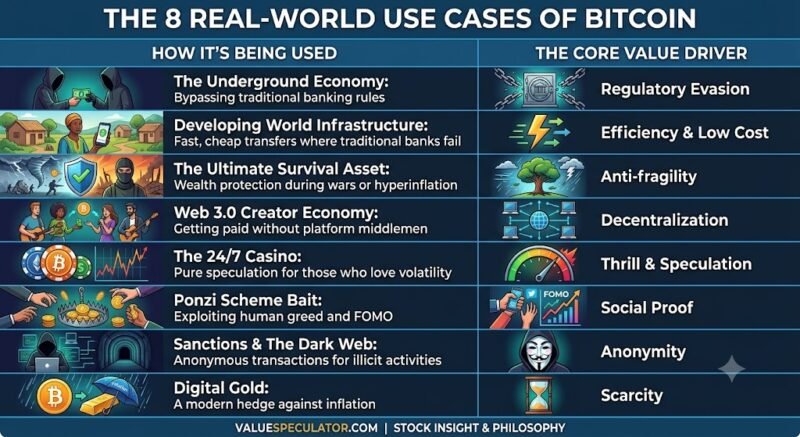
Instead of trying to force a DCF (Discounted Cash Flow) model onto Bitcoin, let’s look at how it’s actually being used out in the wild. If we track its real-world utility, we can start to see what’s actually driving the demand. Here’s what I see:
| How It’s Being Used | The Core Value Driver |
| 1.The Underground Economy: Bypassing traditional banking rules | Regulatory Evasion |
| 2.Developing World Infrastructure: Fast, cheap transfers where traditional banks fail | Efficiency & Low Cost |
| 3.The Ultimate Survival Asset: Wealth protection during wars or hyperinflation | Anti-fragility |
| 4.Web 3.0 Creator Economy: Getting paid without platform middlemen | Decentralization |
| 5.The 24/7 Casino: Pure speculation for those who love volatility | Thrill & Speculation |
| 6.Ponzi Scheme Bait: Exploiting human greed and FOMO | |
| 7.Sanctions & The Dark Web: Anonymous transactions for illicit activities | Anonymity |
| 8.Digital Gold: A modern hedge against inflation | Scarcity |
Munger’s Trick: Invert, Always Invert
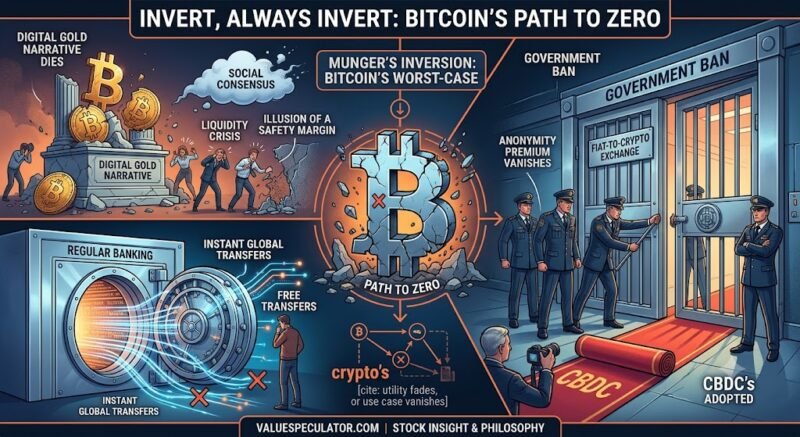
To really figure out an asset, you have to look at the worst-case scenario. What would it take for this asset to go straight to zero? If we apply Charlie Munger’s inversion rule to Bitcoin:
- The Government Ban: If central banks roll out their own digital currencies (CBDCs) and aggressively shut down fiat-to-crypto exchanges, the anonymity premium vanishes.
- Tech Obsolescence: If the regular banking system gets its act together and makes global transfers instant and free, a massive chunk of crypto’s
- The Psychological Snap: If the “Digital Gold” narrative dies during a severe liquidity crisis, the social consensus evaporates. And with it, any illusion of a safety margin.
The Bottom Line: Investing vs. Speculating
With traditional stocks, we can crunch the numbers on earnings and cash flows to find an anchor. Crypto just doesn’t play by those rules.
Does that mean it’s totally worthless? No. As we saw with the 8 utilities, it has a real function in the world. But because we can’t mathematically measure that value, there is absolutely zero “margin of safety.” You are fully exposed to market psychology and wild price swings.
Because of this, I don’t invest in Bitcoin, and I don’t speculate on it either. I’m sticking to my playbook: businesses with massive economic moats, overflowing free cash flow, and dividends I can rely on. If you do decide to jump into the crypto waters, just be honest with yourself: Are you buying it for its actual utility, or are you just betting that the price will go up