Controlling Portfolio Risk: The Art of Dollar-Cost Averaging and DiversificationThe Core of Investing: Risk Management

The Core of Investing: Risk Management

Many investors mistake investing for a game of maximizing returns. However, true value investing begins with managing risk. No matter how high the potential return of an asset is, you must not commit your capital if the risk of ruin is high. Protecting your capital is the ultimate “Margin of Safety.”
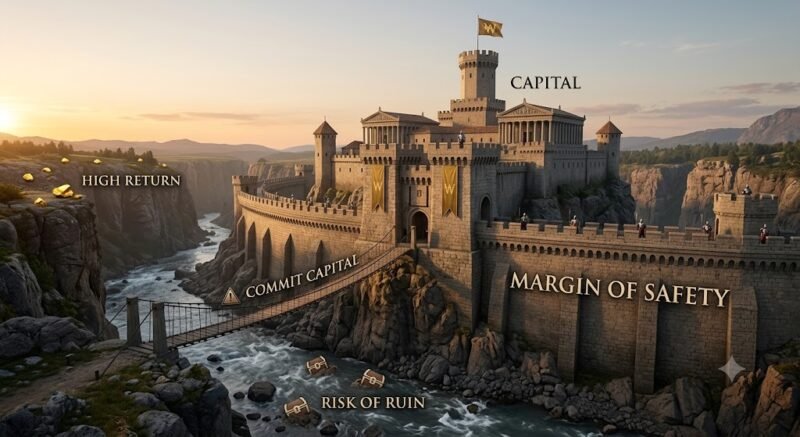
A monumental, fortified castle structure built on a secure rock plateau, symbolizing protected 'Capital'. It is protected by a massive, deep fortified stone wall labeled 'MARGIN OF SAFETY' that extends far into the landscape, with multiple defensive layers. A treacherous suspension bridge spans a canyon below, with subtle warning icons near the path to 'COMMIT CAPITAL'. Gold nuggets labeled 'HIGH RETURN' are on an opposite cliff but are hard to reach, separated by 'RISK OF RUIN' icons in the dangerous river. The composition visualizes successful risk management as a deep, defensive barrier rather than a dangerous pursuit of returns, with warm golden hour lighting and high-detail text.

The Traps of Faulty Diversification

We often hear the golden rule: “Don’t put all your eggs in one basket.” This is the core concept of diversification. However, simply buying multiple stocks does not mean you are safely diversified.

Consider the severe downturn of the South Korean shipbuilding and shipping industries in the 2010s. If an investor back then had built a portfolio consisting only of Hanjin Shipping, Hyundai Merchant Marine, STX, Samsung Heavy Industries, and Daewoo Shipbuilding & Marine Engineering, that investor would still not have recovered their losses today in 2026.

Even though the portfolio spread across five different companies and two different sectors, it failed. Why? Because shipping and shipbuilding share the same economic destiny. They are highly correlated. True diversification requires spreading capital across sectors that move independently of one another—such as technology, finance, and consumer goods.
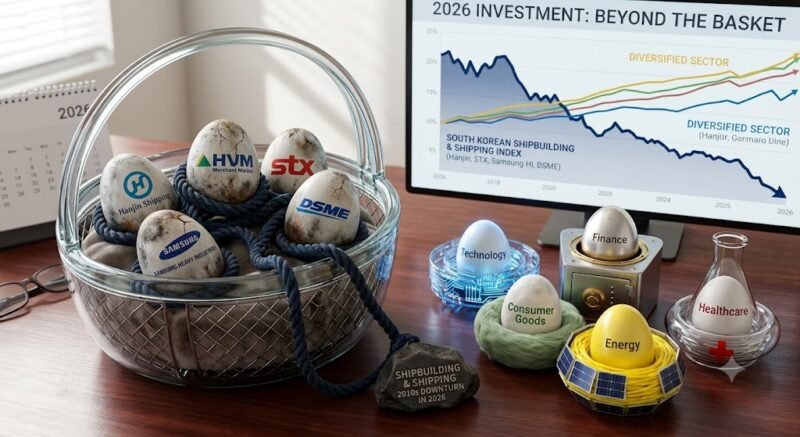
A detailed 2026 visualization contrasting correlated and diversified portfolios. On the left, a fragmented wooden structure labeled 'CORRELATED PORTFOLIO: SHIPBUILDING & SHIPPING DOWNTURN' holds five cracked, weathered, rusted 'eggs.' All five—distinctly labeled 'Hanjin Shipping,' 'Hyundai Merchant Marine,' 'STX,' 'Samsung Heavy Industries,' and 'DSME'—are tightly bound together by a thick, dark ship's rope, emphasizing high correlation. To the right, four separate, pristine 'nest' structures represent 'TRUE DIVERSIFICATION: INDEPENDENT SECTORS.' Each nest contains one clean egg and is made of unique materials: 'TECHNOLOGY' in glowing circuits, 'FINANCE' in a metallic safe nest with gold, 'CONSUMER GOODS' in velvet and cotton, and 'ENERGY' in yellow solar-themed materials. In the blurred background, a large digital screen contrasts downward-trending blue lines for correlated assets with distinct upward-trending lines for diversified indices.

Dollar-Cost Averaging (DCA): The Power of the Staircase Approach

While diversification spreads risk across space (sectors), Dollar-Cost Averaging (DCA) spreads risk across time.

Many retail investors make the mistake of deploying all their cash at once, driven by the fear of missing out (FOMO). A disciplined investor, however, moves like a well-trained army, deploying capital sequentially. Think of it as a “staircase approach.” By buying in calculated tranches, you lower your average cost basis and build a psychological buffer against market volatility.
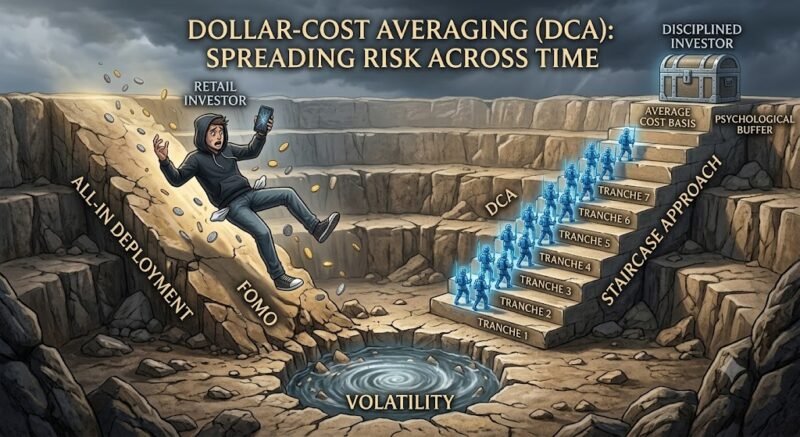
A conceptual visualization contrasting two investment approaches in a volatile market. The scene is a dramatic cross-section of stone terraces under a stormy sky, similar in texture to image_17.png and image_20.png. On the left, a stylized 'RETAIL INVESTOR' is shown falling headfirst down a precarious, broken path labeled 'ALL-IN DEPLOYMENT' and 'FOMO', losing capital as coins fly everywhere. On the right, a second visualization shows the 'DISCIPLINED INVESTOR', represented by a well-organized phalanx of small, glowing blue soldiers (like the defense lines in image_20.png), marching up a broad, sturdy, ascending stone staircase labeled 'STAIRCASE APPROACH' and 'DCA'. Each step of the staircase is labeled with an amount: 'TRANCHE 1', 'TRANCHE 2', 'TRANCHE 3', and so on. The staircase structure is rock-solid, rising above the treacherous market volatility pool below. Large text above reads: 'DOLLAR-COST AVERAGING (DCA): SPREADING RISK ACROSS TIME'.

Building an Economic Moat for Your Capital

When you combine true sector diversification with a strict staircase buying strategy, you create a powerful “Economic Moat” around your portfolio. This dual-layered risk management framework ensures that even if one sector faces an unexpected storm, the rest of your fleet remains stable and ready to advance.

Remember, investing is not a short-term sprint; it is a long-term game of survival. By controlling your risk, you allow the law of compounding returns to work its magic over time.
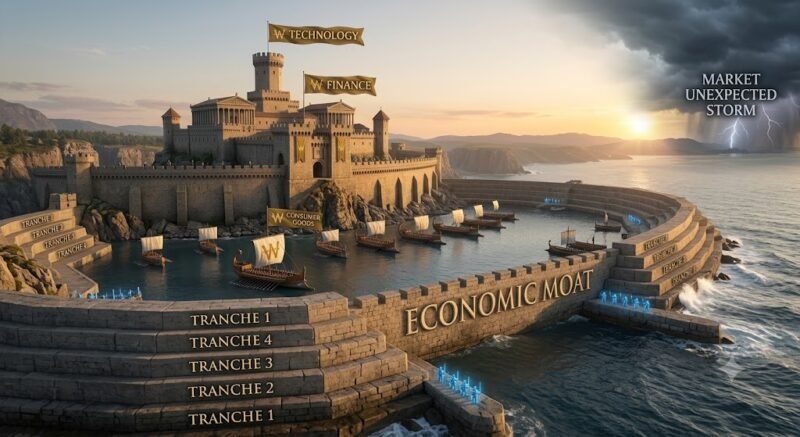
A grand cinematic visualization of a robust financial empire. In the center sits a majestic stone citadel representing the 'PORTFOLIO' and 'CAPITAL', surrounded by deep, swirling blue water labeled 'ECONOMIC MOAT'. Surrounding the citadel are multiple layered defensive walls built of stone blocks, styled after the staircase tiers from image_32.png, with visible inscriptions reading 'SECTOR DIVERSIFICATION' and 'STAIRCASE DCA STRATEGY'. In the calm inner harbor, a disciplined fleet of ships flies flags representing 'TECHNOLOGY', 'FINANCE', and 'CONSUMER GOODS', remaining perfectly stable and unharmed. In the far distance, a dark, turbulent storm with lightning labeled 'MARKET UNEXPECTED STORM' rages over a separate rocky coastline, but its waves break harmlessly against the outer sea walls of the citadel. The lighting is a triumphant sunrise, illuminating the secure layout. Large text across the bottom states: 'BUILDING AN ECONOMIC MOAT: DUAL-LAYERED RISK MANAGEMENT'.

댓글 남기기

Verified by MonsterInsights