
The Core of Investing: Risk Management
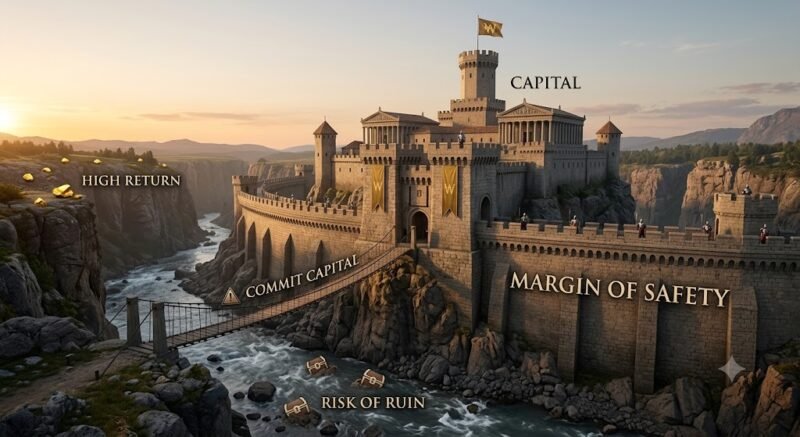
Many investors mistake investing for a game of maximizing returns. However, true value investing begins with managing risk. No matter how high the potential return of an asset is, you must not commit your capital if the risk of ruin is high. Protecting your capital is the ultimate “Margin of Safety.”
The Traps of Faulty Diversification
We often hear the golden rule: “Don’t put all your eggs in one basket.” This is the core concept of diversification. However, simply buying multiple stocks does not mean you are safely diversified.
Consider the severe downturn of the South Korean shipbuilding and shipping industries in the 2010s. If an investor back then had built a portfolio consisting only of Hanjin Shipping, Hyundai Merchant Marine, STX, Samsung Heavy Industries, and Daewoo Shipbuilding & Marine Engineering, that investor would still not have recovered their losses today in 2026.
Even though the portfolio spread across five different companies and two different sectors, it failed. Why? Because shipping and shipbuilding share the same economic destiny. They are highly correlated. True diversification requires spreading capital across sectors that move independently of one another—such as technology, finance, and consumer goods.

Dollar-Cost Averaging (DCA): The Power of the Staircase Approach
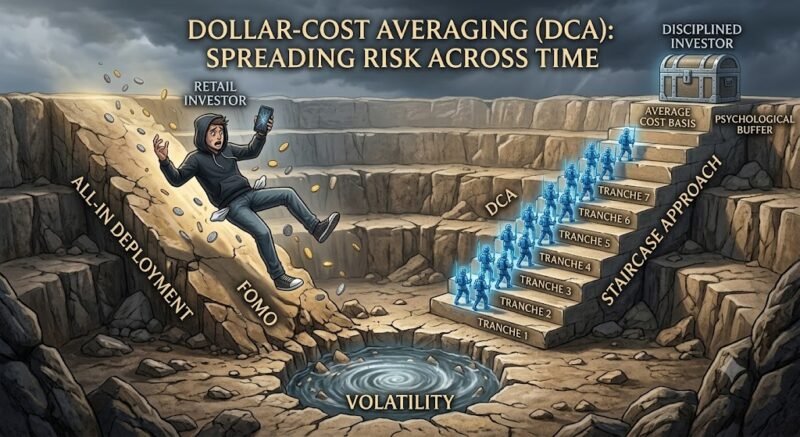
While diversification spreads risk across space (sectors), Dollar-Cost Averaging (DCA) spreads risk across time.
Many retail investors make the mistake of deploying all their cash at once, driven by the fear of missing out (FOMO). A disciplined investor, however, moves like a well-trained army, deploying capital sequentially. Think of it as a “staircase approach.” By buying in calculated tranches, you lower your average cost basis and build a psychological buffer against market volatility.
Building an Economic Moat for Your Capital
When you combine true sector diversification with a strict staircase buying strategy, you create a powerful “Economic Moat” around your portfolio. This dual-layered risk management framework ensures that even if one sector faces an unexpected storm, the rest of your fleet remains stable and ready to advance.
Remember, investing is not a short-term sprint; it is a long-term game of survival. By controlling your risk, you allow the law of compounding returns to work its magic over time.